

Lot 102


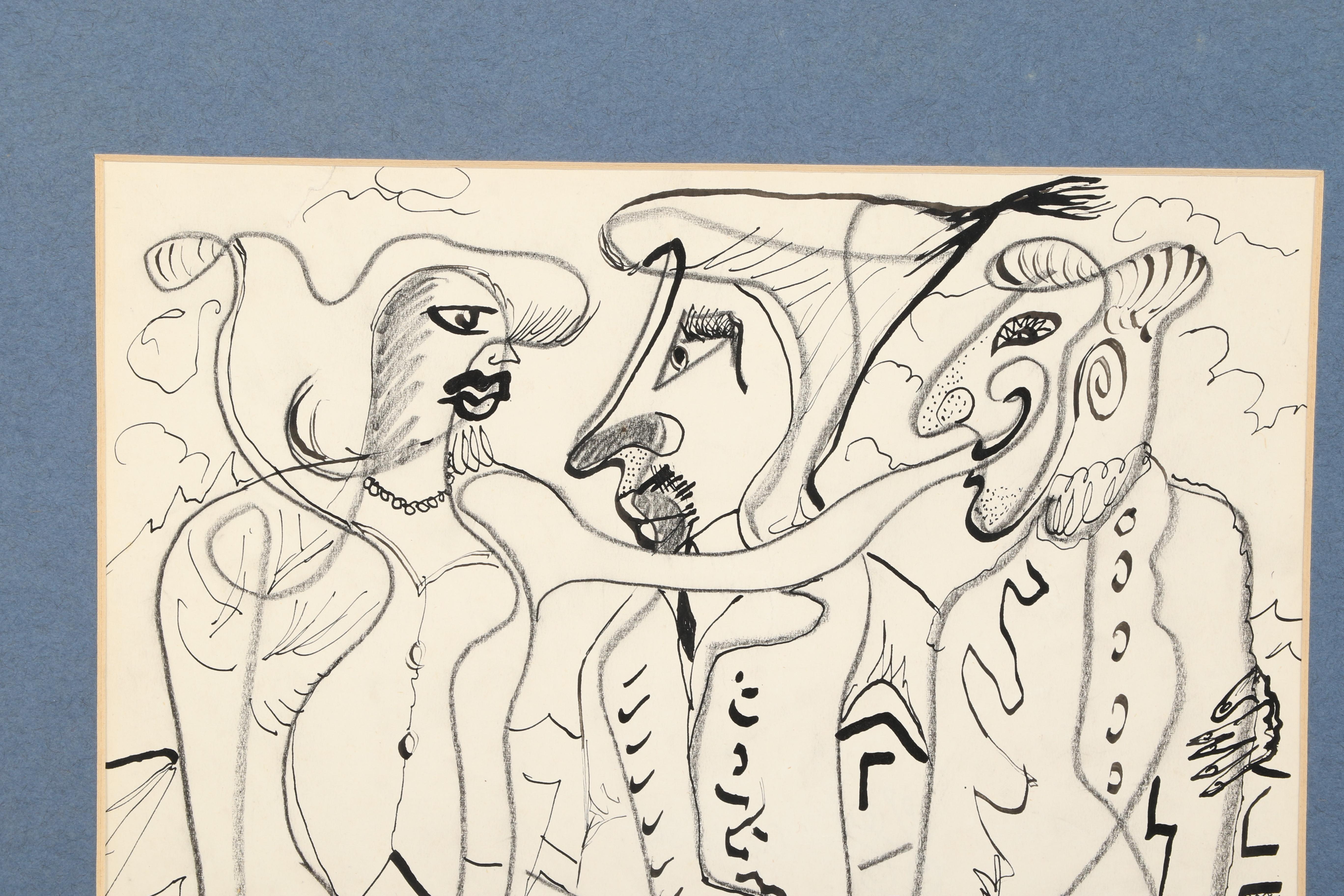


Attributed to Francis Picabia
French, (1879-1953)
3 abstract figures
ink and graphite on paper (laid onto support board)
Unsigned.
Provenance: From the collection of Sir Lawrence Gowing (1918-1991), trustee of the British Museum, of the National Portrait Gallery and of Tate Gallery.
Biography from the Archives of askART: French painter Francis Picabia is best known as an early pioneer of the Dada movement. Between 1915 and 1917, he lived periodically in New York where he was active in the New York Dada group. There he met Alfred Steiglitz, Man Ray, Walter Arensberg and Beatrice Wood, among others. Picabia was involved with a number of Dada publications, including '391'. He traveled between the New York, Zurich, and Paris Dada groups taking ideas from one place to the others.
Francis Picabia was born in Paris in 1879 into a family of mixed parentage with a French mother and Spanish father. He studied at the Ecole des Beaux-Arts and at the École des Arts Décoratifs of Paris. Up to 1908 he painted landscapes in the manner of Corot and the Impressionists, especially Sisley. Then, influenced by Matisse's Fauvism on one hand and by the Cubism of Braque and Picasso on the other, Picabia tried to combine both movements and created bright-colored Cubist pictures unlike the somber monotone paintings of Cubism's founders.
In 1910 Picabia met the Duchamp brothers, Marcel Duchamp and Raymond Duchamp-Villon. The friendship with Marcel Duchamp (1887-1968), a pioneer in the use of ready-made art, significantly influenced Picabia's following works.
In 1913, Picabia and his wife, Gabrielle Buffet-Picabia, went to the United States for the first time where he showed his abstract paintings at the international Armory Show exhibition in New York. The pictures had success and brought him fame. When the Picabias returned to Paris after the Armory show, they brought stories of the vitality of the New York art scene, fueled by Alfred Stieglitz's 291 gallery and the salons which were already forming in Walter Arensberg's home. Combining this information with the romanticized America they were seeing in film and reading about in books, countless Parisian artists were drawn towards New York.
During his second stay in New York in 1915, Picabia, together with Marcel Duchamp and painters of American avant-garde formed the New York Society of Dadaists. The group published the periodical '291', to which Picabia contributed.
In 1917, Picabia published his periodical, which he called '391' to remind him of the American group's 291. In '391' he published his first "Mechanical Drawings". Leaving geometrical abstractions, Picabia started a series of compositions, in which technical drawings suddenly developed shapes of human figures (Ici, C'est Ici Stieglitz. 1915; Young American Girl in a State of Nudity, 1915; Parade Amoureuse, 1917). These "mechanomorphs" full of humor, teasing Dadaist sarcasm, demonstrate the paradox of visual perception.
In 1917, back in the United States once more, he published further numbers of his periodical, assisted by Marcel Duchamp. In Europe, the periodical '391' was published until 1924.
In 1918 Picabia moved to Switzerland, where he joined the Zurich group of Dadaists.
In 1921 he dissociated himself from "orthodox" Dadaists and switched his allegiance to Surrealism*. In the early 1920s Picabia was interested in 'constructing' collages, for which he used all kind of materials (Feathers, 1921; Straw Hat, 1921, Woman with Matches, 1923-24)
In 1927 Picabia's period of so-called 'transparencies' started. The artist was looking for alternative methods to depict three-dimensional space without traditional rules of perspective. He developed this approach in his works, in which flat images overlay and interlace to show an object from a variety of viewpoints.
In 1934, he abandoned his transparent images in favor of the heavy shapes of pseudo classicism. Exaggerating the manner of the self-taught Primitivists and Kitch stylistic, Picabia parodied the "high" genres of allegory, portraiture and Mythological scenes.
During the World War II (1939-45) Picabia lived in Switzerland and in the south of France. After the end of war he returned to Paris, where he came into contact with the Existentialists. In his late works abstractions alternate with the grotesque. Picabia also worked for the theatre, designed decorations for festivals and Gala-shows.
Some names associated with Picabia include: Marcel Duchamp, Tristna Tzara, Erik Satie, Richard Huelsenbeck, Hans Richter, Emmy Hennings, Hugo Ball, Walter Arensberg, Jean Arp, Kurt Schwitters, and Diter Rot, as well as Alfred Stieglitz's and his Gallery 291 of New York.
Picabia's work is held in the Permanent collections of the following museums: The Museum of Modern Art in Manhattan, The Art Institute of Chicago, the Guggenheim Museum, The Whitney Museum of American Art, among others.
Sources:
Francis Picabia. His Art, Life and Times. By W.A. Camfield. Princeton. 1979.
Picabia. By M. L. Borras. Barcelona-Paris. 1985.
Francis Picabia: Accommodations of Desire 1924-1932 by Sarah Wilson.
The Dada Painters and Poets: An Anthology, Harvard University Press
Dada, Surrealism, and Their Heritage by William S. Rubin
Written and submitted by Jean Ershler Schatz, artist and researcher form Laguna Woods, California.
- Dimensions: 14"H x 10 1/4"W (sight), 20 1/2"H x 16 1/4"W
- Medium: ink and graphite on paper (laid onto support board)
Accepted Forms of Payment:
ACH, American Express, Discover, MasterCard, Money Order / Cashiers Check, Personal Check, Visa, Wire Transfer
Shipping
Shipping and removal are the sole responsibility of the buyer. Shipping is available by request through a third party shipping service, Shipping Saint. Please contact our office if you would like to arrange your own shipping. Buyers will not automatically receive a shipping invoice. You will be sent a separate invoice for shipping once your initial invoice is paid and your items are packed and ready to ship. Shipping is invoiced via Shipping Saint and cannot be combined with your auction invoice.
Shipping Saint can be contacted at [email protected] or via phone, 317-644-6088.
PICKUP: Pickup is by appointment only. Items are subject to storage fees if they are not removed from premises within 10 business days. If items require shipping, arrangements and removal must be completed within 15 business days.
Ripley Auctions
You agree to pay a buyer's premium of 25% and any applicable taxes and shipping.
View full terms and conditions
| From: | To: | Increments: |
|---|---|---|
| $0 | $99 | $10 |
| $100 | $199 | $20 |
| $200 | $499 | $25 |
| $500 | $999 | $50 |
| $1,000 | $2,999 | $100 |
| $3,000 | $4,999 | $200 |
| $5,000 | $9,999 | $500 |
| $10,000 | $29,999 | $1,000 |
| $30,000 + | $2,500 |