

Lot 1


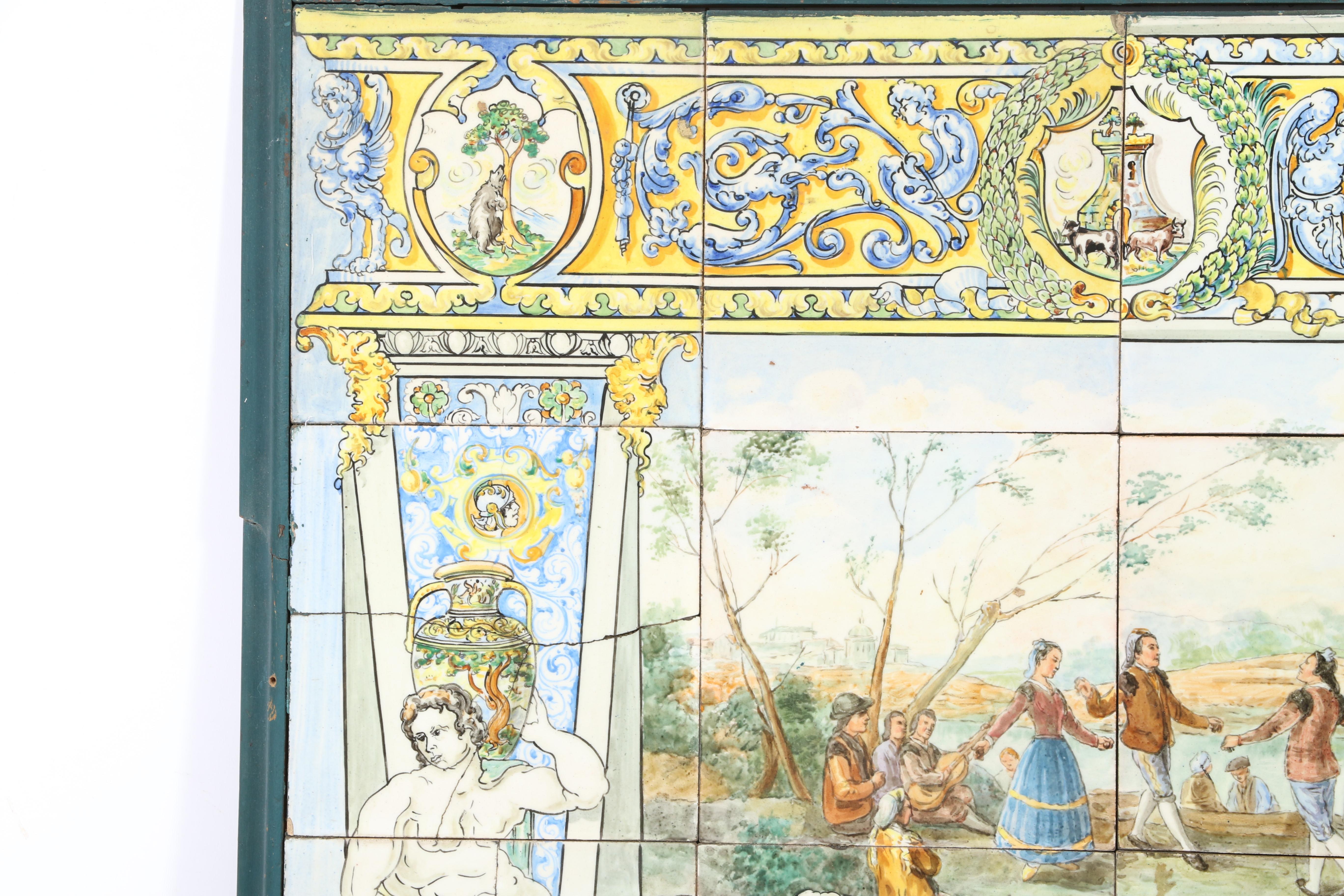


Enrique Guijo, Madrid, (1871-1945), framed Spanish Azulejo Majolica tile mural panel depicting Goya's El baile en San Antonio de la Florida, Museo del Prado, signed.
Several cracked tiles and a piece of the frame is broken.
This forgotten Córdoba artist constituted the key to the renaissance of Talavera ceramic in the beginning of the XXth century. He founded the School of Ceramic of Madrid, directed it and taught there. He is responsible for one of the capital's distinguishing features: its commercial tiles.
Enrique Guijo was born in Córdoba in 1871, son of a carpenter who died when he was only 14. This forced him to quit school and then work. Chance took him to the Triana ceramists where he had the first encounter with the trade in which he would later be an expert.
Along with his wife and his newly born daughter, Guijo settled in Madrid (Travesía de la Parada 7) in 1898, by then he was already an expert ceramist. Soon he begun working with Francisco Álvarez Osorio, Ignacio Calvo y Narciso Sentenach, with whom he put together a kiln.
In 1907, advised by his friend Daniel Zuloaga, also a ceramist, Enrique Guijo traveled to Talavera with the sole idea of reproducing old Talavera ceramic works. He carried out tests in the pottery of "El Carmen" where Ruiz de Luna Rojas, photographer and ceramic painter, worked. The negative from Emilio Niveiro, director of the pottery of "El Carmen", to hold the fabrication of ceramic using the old Talavera technique resulted in Juan Ruiz de Luna Rojas, Platón Páramo, Juan Ramón Ginestal and Enrique Guijo Navarro creating a society to that end. They named the pottery "Nuestra Señora del Pardo" (Our Lady of el Pardo), Saint of Talavera, as the grand opening took place the same day in which Our Lady of el Pardo is celebrated: the 8th of September (1908). That day begun the renaissance of the Talavera ceramic. It was a time of beginnings and first achievements that lasted until 1915, year in which Guijo would go back to Madrid.
The times of splendor of the Talavera ceramic, long forgotten by 1907, had reached its peak with tile work of the El Escorial Monastery commissioned by Felipe II (Philip II). Enrique is nowadays considered the great restorer of Talavera ceramic.
After the dissolution of the society he formed in Talavera with Ruiz de Luna, Guijo worked a few years in a establishment in Mayor street as subsidiary for Ruiz de Luna and, then, in 1920 opened his own pottery in Carabanchel, where, among others, worked the exquisite apprentice Alfonso Romero Mesa. Romero and Guijo made the famous ceramic works of the old Villa Rosa, in Santa Ana square, around 1928. The following year Romero would start his own pottery.
Along with Alfonso Romero, Juan Ruiz de Luna y Rajel, all of them born in Andalucía, he decorated many commercial establishments in the early XXth century. They even worked together in the famous tile of "Los Gabrieles" Tavern, opened in 1920 and considered by many as the "Sistine Chapel" of commercial tiles. The place had for a long time the honor of being a meeting point for the aristocrats and the bourgeois. Inside we find Enrique Guijo's mural of the skeletons' rumba, inspired by the work of Jerez painter Carlos González Rajel.
Other important work by Enrique Guijo was the facade of the Bakery House in Plaza Mayor that he made in 1914 and that was later, in 1992, replaced by Carlos Franco's work. He also did ceramic advertisements in the metro station of Chamberí, the Egg shop and the Juanse Pharmacy in the popular neighborhood of Malasaña. Guijo also took work from Mariano Benlliure and Joaquín Sorolla.
In 1926 he was appointed curator in the Municipal Museum of Madrid, to which the artist had previously donated its ceramic works, key and foundation for the section dedicated to pottery in this museum. The director then was his dear friend Manuel Machado who said about Guijo:
"Enrique Gujio, a Renaissance soul, curious about all arts, never renouncing to ceramic nor the fascinating and yet terrible viper that is always the kiln, went away to explore and expanded his art into other applied and luxury arts: architectonic decoration, furniture, ébániste, artistic forging... "
Although both Madrid and Talavera town-halls had long ago approved to name a street after this great and ignored artist, to this day Enrique Guijo is nowhere to be found among their streets. Enrique died forgotten and almost blind in 1945, though, academics don't quite agree on the exact year of his death.
- Dimensions: 19 1/4"H x 25 1/4"W (frame)
Accepted Forms of Payment:
ACH, American Express, Discover, MasterCard, Money Order / Cashiers Check, Personal Check, Visa, Wire Transfer
Shipping
SHIPPING: Large or fragile items will require a third party shipper. Items that require third party or local pickup are indicated within the lot description. If we cannot ship your item, email [email protected] for a list of recommended shippers. Buyer is responsible for obtaining quotes and arrangement of third party shipping.
Successful bidders will receive an invoice following the auction that will include payment details. Please check your spam/junk folder if you do not receive an invoice.
After payment is made, your order will go to our shipping department if it does not require third party. Buyers will not automatically receive a shipping invoice. You will be sent a separate invoice for shipping once your initial invoice is paid and your items are packed and ready to ship. We guarantee that we will provide the highest standards in packing and handling available, in a time frame that allows attention to every detail to protect the items you have purchased.
It will ask you to verify your address before paying by credit card.
PICKUP: Items are subject to storage fees if they are not removed from premises within 10 business days. If items require third party shipping, arrangements and removal must be completed within 15 business days.
Ripley Auctions
You agree to pay a buyer's premium of 25% and any applicable taxes and shipping.
View full terms and conditions
| From: | To: | Increments: |
|---|---|---|
| $0 | $99 | $10 |
| $100 | $199 | $20 |
| $200 | $499 | $25 |
| $500 | $999 | $50 |
| $1,000 | $2,999 | $100 |
| $3,000 | $4,999 | $200 |
| $5,000 | $9,999 | $500 |
| $10,000 | $29,999 | $1,000 |
| $30,000 + | $2,500 |